1,00,000 Robots, Zero Layoffs

Posted July 17, 2026
Chris Campbell
You’ve probably heard the story…
William Stanley Jevons warned Britain was burning through its coal. Everyone said efficiency would save them. Better steam engines, less coal.
Jevons said the opposite would happen. He was right. Watt's engine made coal more useful, so Britain burned more of it.
Efficiency expands the market. It doesn't shrink it.
Now the part everyone forgets about automation: ATMs.
The cash machine automated the teller's core job. Tellers per branch fell from about 20 to 13.
Everyone predicted a bank teller bloodbath, but the opposite happened. Branches got cheap to open. So banks opened them everywhere.
Branch count grew over 40%. Total teller jobs in America grew roughly 10%. And the tellers who remained spent their days on mortgages and small business loans instead of counting twenties.
That lasted fifty years.
We’re about to see a similar shift with robots. And it flips everything we’ve been told about robots on its head.
Hollywood Lied to You
How fast are we screwed?
That's the only question anybody actually has about robots. Everything else is throat-clearing.
The problem: The most powerful technology in human history arrives with the public relations profile of a villain’s origin story.
The problem with that problem: we've been getting our robotics education from a genre where the machine has to turn evil or the plotline sucks.
The problem behind both problems: we’ve all agreed, without discussing it, robots will replace muscle.
But muscle is a commodity. You can hire it, train it, ship it, schedule more of it. Every economy on earth has a lever for getting more of it.
Getting more brains, however? That’s the big bottleneck.
Large retailers lose hours of productivity per employee per day. And not (always) because people are lazy. It’s largely because figuring out what should be priority is insanely difficult.
The manager requires superhuman skills: one who can walk every aisle throughout the day with perfect memory and infinite patience.
Those don’t exist. But robots that can do that already do.
This isn’t limited to retail.
Zooming out, every business in every sector runs the same loop: capture what's happening, analyze it, decide, execute.
Execution is the part everybody can see, so it's the part everybody manages. Capture is the part nobody's ever been able to afford.
You can't decide well about a store, a field, a warehouse, or a ward you can only see in fragments. Reality is always bigger than any one person's attention span.
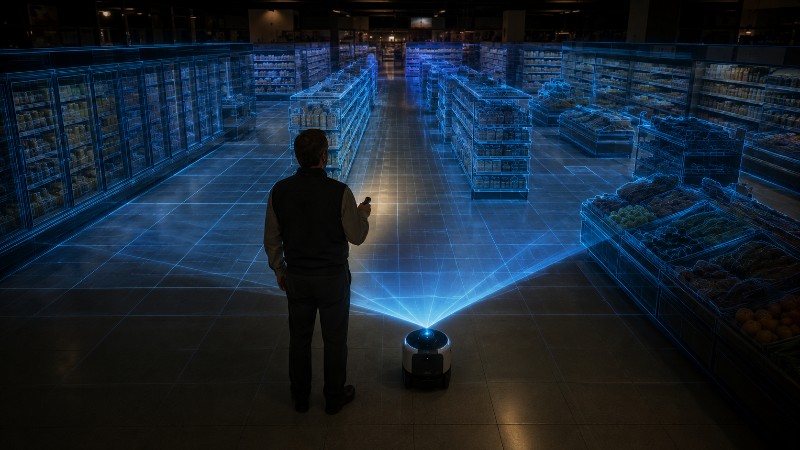
So while the world obsesses over robots that can flex and execute, the actual value comes from the robot that can survey a building overnight and hand the staff a ranked list first thing in the morning.
The Contrarian’s Robot Thesis
In short, most tasks worth automating probably aren’t the jobs people already do.
They're the jobs nobody could ever afford to hire for. The stuff too repetitive, too constant, too expensive to staff. The ones that don't even exist today.
By 2030, analysts expect 100,000 store manager robots deployed in grocery stores alone. And 1 million by 2030. By next Christmas, several million people will probably see one in a store.
It’s likely few jobs will be destroyed in that process.
Then that sequence will repeat. Warehousing. Logistics. Agriculture. Healthcare. Hospitality.
Every one of these industries runs on a person making a hundred decisions a day with a tenth of the information required to make them well. Even the most experienced rely on guesswork.
Give that person the full picture distilled and the nurse gets her hours back, the agronomist gets to practice agronomy, and the blight gets caught on Tuesday instead of the following Tuesday.
Unfortunately, that adds up to a movie too boring for Hollywood.
In reality, though, it means more stores, closer to where people live. Cheaper food. Better jobs. Somebody's kid gets a first summer job and somebody's mom gets a new career.
That's what abundance looks like. Nobody loses their dignity in the deal.That’s the contrarian side of the robot trade. And it’s the one I’m taking. More on how—in crypto and stocks—soon.