AI Prevents “Starmageddon”

Posted February 25, 2026
Chris Campbell
Every civilization has blind spots.
Our biggest one floats 93 million miles away.
Looking up from Earth, the Sun feels composed and predictable.
Warm. Reliable. Generative.
The quiet star that feeds chlorophyll, sparks biology, and gives solar tech daily bursts of intermittent glory.
But the Sun, contrary to what the ancients may have thought, isn’t a benevolent lantern hung in a perfectly orderly sky.
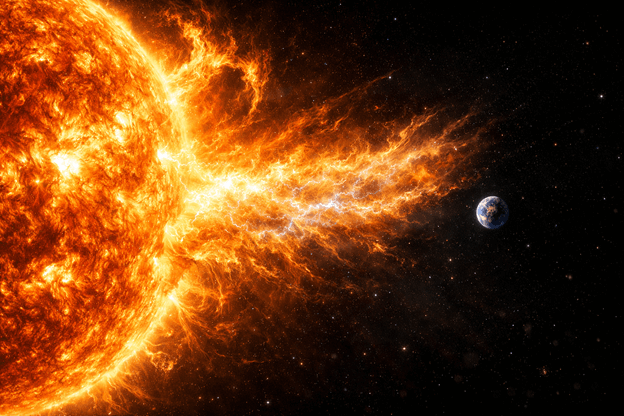
It’s also an unfathomably large nuclear engine that occasionally hurls billions of tons of charged plasma toward Earth at a million miles per hour.
And if you’ve grown even a little fond of functioning systems, that’s becoming a fairly big deal.
Starmageddon
When the Sun heaves a lot of plasma, things we’d prefer not to happen can happen.
Satellites get temperamental. GPS develops creative interpretations of “location.” And the grid starts vibrating with a tone no country budgeted for.
We’ve known this.
The Carrington Event in 1859 gave us plenty of warning.
We build satellites, grids, and GPS networks on the assumption the Sun will stay within historical patterns—volatile, yet statistically manageable.
We trust the odds and our backup plans. But the Sun doesn’t sign contracts. Real resilience means seeing the punch before it’s thrown.
Right now, with AI-driven forecasting, we’re finally getting a good glimpse of the wind-up.
Terrible Name. Serious Potential.
A new AI system called PINNBARDS—short for Physics-Informed Neural Network-Based Active Region Distribution Simulator—confirms what I’ve long suspected:
Physicists experience great joy when even an acronym can make the average eye glaze in retreat.
But name aside, the technology behind it will likely earn a permanent chair inside every space weather operations center.
Built by scientists at the Southwest Research Institute, this new system sits inside a broader wave:
Physics-informed AI models that blend magnetohydrodynamics—the physics of electrically charged fluids moving inside magnetic fields (mercifully shortened to MHD)—with machine learning.
Traditionally, space weather forecasts could only give us hours of reliable warning.
Sometimes less.
But that’s like getting a hurricane alert when the wind is already ripping shingles off your roof.
MHD-AI has the potential to stretch that window to weeks.
Weeks.
The Most Important Use of AI
Our economy increasingly runs on orbital hardware, synchronized clocks, and continent-spanning transmission lines.
We built a civilization that depends on invisible electromagnetic stability.
With weeks of notice:
- Satellite operators can put sensitive systems into safe mode.
- Grid managers can rebalance loads and isolate vulnerable transformers.
- GPS-dependent systems can build redundancy into timing networks.
- Astronauts can shelter in shielded compartments.
- Polar flights can reroute before radiation spikes.
In this respect, AI is sharpening our vision for large-scale instability. And that may be one of the most important uses of artificial intelligence so far.
Not replacing artists. Not writing emails.
Standing guard over the grid.
If we’re ever dragged back to the Stone Age, it probably won’t begin with a burning streak overhead.
It will arrive as cascading systems failure.
And the difference between catastrophe and inconvenience? A running start.