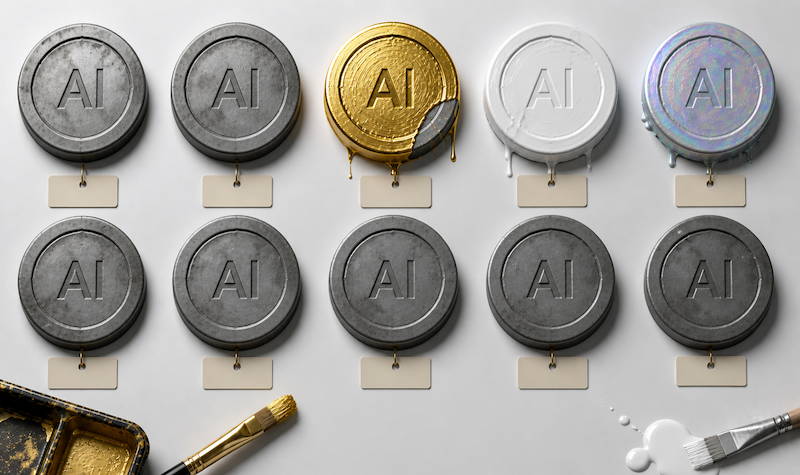
AI’s Painted Token Test

Posted May 05, 2026
Chris Campbell
Last week, Anthropic ran a quiet experiment.
They took Claude Code—their flagship coding agent—and stripped it out of the $20 plan for a slice of users.
No warning. No announcement. Just a price gate.
Want to keep using it? That'll be $100 a month, please.
Some users paid. Some walked. Anthropic learned exactly what they needed to learn—how much pain the market will swallow before it moves on.
The technique is called the painted door test. Show a higher price to a fraction of visitors.
Measure who flinches.
The math is simple. Lose 5% of customers, raise prices 10%, and the area under the curve grows.
To be sure, Anthropic isn't the only one running the play.
Two days later, Microsoft quietly rewired GitHub Copilot. The old model was clean—you bought a flat plan, you got a fixed number of agent actions.
Run a cheap model or a premium one, same bucket.
That's gone.
Today, every action burns tokens. Use a small, fast model and your tokens last. Use Anthropic's premium Opus—roughly 20x the cost—and they evaporate.
Microsoft makes money. Microsoft has cash flow most companies fantasize about. And Microsoft is still tightening the belt on AI usage.
That should tell you something.
Let’s talk about what that “something” is (and where I think it will inevitably lead us.)
The Bill Comes Due
OpenAI just raised $120 billion.
It sounds like a war chest….
But it’s not.
At their current burn rate—$5 to $7 billion a month—that pile buys them 18 to 24 months. Then they raise again. Or they start making money. Or both. Or neither—anything can happen.
Anthropic is in the same boat.
Every new model means billions in training costs. Opus 4.6 cost a fortune. Opus 4.7 cost more.
By the time the next version ships, nobody is using 4.7 anymore. That training spend has to be recouped through inference—actual paying usage—or it's burned capital.
The defenders will tell you these companies "make money on every request."
Technically true.
But the overhead is still astronomical.
Training costs. Data center buildouts. Talent wars. Compute leases.
Meanwhile, on the other side, Uber just admitted they burned through their entire annual AI budget in four months.
Four.
They told employees to use AI maximally. Employees did exactly that. Now the CFO is looking at a hole in the floor.
This is happening everywhere. It just isn't being announced.
The Real Winner
A token in AI parlance is the smallest unit of language an AI model processes—roughly three-quarters of a word, priced in fractions of a cent.
The token economy is real.
It's just shifting underneath everyone's feet.
Every action—every code generation, every research query, every agent call—has a metered cost now.
The era of "unlimited usage for $20" is dying on the vine. What replaces it is a per-token, per-task, pay-as-you-go economy.
That economy needs rails.
It needs a payment system fast enough and cheap enough to handle billions of micro-transactions. Credit card networks weren't built for this. Bank wires weren't built for this. PayPal definitely wasn't built for this.
You know what is built for this? Crypto. Stablecoins. On-chain settlement. Programmable money that moves in fractions of a cent without a human in the loop.
While the AI giants fight over how to charge you $200 a month, the real infrastructure shift is happening underneath.
Agents will pay agents. Models will buy compute on the spot. Tasks will route to whoever can deliver them cheapest, fastest, and best.
The companies with the biggest upside aren’t the ones running painted door tests on their pricing pages.
They're the ones building the rails the tokens—crypto tokens and AI tokens—flow through.
The Painted Token
The AI revolution is finally getting priced.
When the subsidies end, the real economy will begin.
It looks like meters running on every prompt, agents transacting with agents, and rails most retail investors aren't watching yet.
Watch the picks-and-shovels. Watch the payment infrastructure being built quietly underneath.
The painted doors are becoming painted tokens.
What happens next will change everything.