
Elon Musk's DeFi Mullet

Posted March 27, 2026
Chris Campbell
Want to know where a company is going?
Don't read the press releases.
Watch who they hire.
Last week, Elon Musk made his next move.
X quietly hired Benji Taylor—a crypto-native designer—to lead design across the entire X platform.
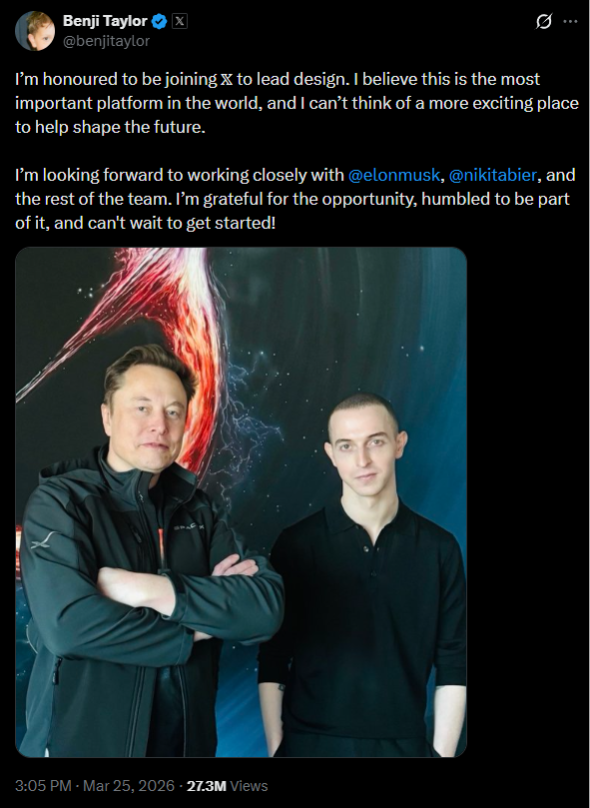
No press release. No fanfare. Just a LinkedIn update and a ripple through fintech Twitter.
That's how you know it's real.
Here's what most people are missing.
Who is Benji Taylor?
ARK Invest's Director of Digital Asset Research said the Taylor hire "may be underestimated by many" and that wallets, on-chain payments, and DeFi are now "increasingly likely" on X's roadmap.
In cryptoland, Benji has been making waves for almost a decade.
At 20, he built what the crypto industry called the best-designed self-custody wallet ever made.
Multi-chain. Biometric keys. No seed phrases. Transaction simulations with security warnings. Fiat on-ramps via Stripe. The whole thing audited by one of the top security firms in the space.
Aave, a major DeFi platform, took notice.
Aave acquired his entire company in 2023 and made him Chief Product Officer. He spent two years running product for a $42 billion DeFi lending protocol and its native stablecoin.
Then Coinbase poached him to lead design at Base—their Ethereum Layer 2 network. The low-cost, high-throughput infrastructure purpose-built for payments at scale.
Nikita Bier spent six months recruiting him to X.
Six months.
Here's what his career tells you about what X Money is actually building.
The Easy Button
The Venmos and Cash Apps of the world are already nervous. If they’re not, they should be.
X has distribution—hundreds of millions of accounts, and a user base that skews toward exactly the demographic that moves money and takes investment risk.
But the real opportunity isn't in creative payment disruption.
It's what X Money becoming a crypto on-ramp could do to crypto.
Think about the barrier to entry right now.
You need a separate (and complicated) crypto account for most cryptos.
You might need to understand wallets, gas fees, the whole liturgy.
X Money makes it a button.
You're already on X.
Maybe you’re already paying for a subscription or tipping a creator. You tap a button. No new app. No new account. No new anything.
That's the X Money crypto layer.
A wallet experience so clean you forget it's a wallet. Stablecoin payments that feel like Venmo. DeFi yield that feels like a savings account. Crypto infrastructure made invisible.
The DeFi Mullet Trade
The “obvious” plays are Coinbase (COIN) and Circle (CRCL). Everyone sees those.
COIN either partners with X or gets disintermediated by it—complicated story, worth watching. CRCL could win quietly if X goes stablecoin-first.
Fine.
But the more interesting trade is the one nobody's talking about.
The DeFi mullet.
Business in the front, party in the back.
The front end is centralized, clean, consumer-friendly—your grandma can use it. The back end settles on decentralized rails the user never sees and doesn't need to understand.
X Money is the mullet. Polished X interface up front. Crypto infrastructure underneath.
And, the thing is, the decentralized back-end protocols capture the volume without needing mass consumer adoption on their own.
They win every time a new "easy" front-end scales up, regardless of which front-end wins.
The mullet trade is essentially: let the Elons solve the UX problem, then own the infrastructure he builds on top of.
What Everyone’s Ignoring
Here's the signal buried inside the signal buried inside the signal.
Every product Taylor has ever shipped lives on the Ethereum stack—mainnet, Base, Optimism, Arbitrum.
He's never touched Bitcoin’s Lightning Network. Never worked with XRP.
His entire professional DNA is Ethereum native.
Given his background and what X has been doing, here’s what I reckon is probably coming, and when:
Near-term: Stablecoin payments and the invisible wallet ship together as a single feature. USDC lands in an email/passkey account. No seed phrase. You don't even know you have a wallet. That's the point.Taylor built fiat on-ramps into Family via Stripe. He ran the GHO stablecoin product at Aave. This is his most natural design territory, and it solves the volatility problem without asking users to think about volatility.
Medium-term: The wallet opens up—EVM chain support, dApp connectivity, token swaps. The infrastructure Taylor built at Family, fully unlocked. The chain underneath will almost certainly be Ethereum-compatible. Base is a strong candidate—low cost, USDC-native, and Taylor just spent six months living inside it.
Longer-term: DeFi yield baked into the savings account. Tokenized creator payments. ConnectKit-style developer tools—letting third parties build financial products on X's rails the way apps are built on Stripe.
The roadmap is more than speculation. It's his résumé, read forward.
Though Ethereum might not be the “one chain to rule them all,” I’m betting ETH will be a focal point.
Whatever the case…
Some might be eager to frame this as a zero-sum story between X Money and crypto.
It’s not.
In fact, X Money might be the thing that finally makes the back-end protocols matter at consumer scale.
Taylor's hire tells you the bridge now has a crypto lane.
The negotiation over the future of money is heating up.
Embrace the mullet.