Elon's Lucky Day

Posted September 22, 2026
Chris Campbell
Eighteen years ago this Monday, a small rocket called Falcon 1 reached orbit on its fourth try.
SpaceX had failed three times.
It had money for one more shot.
If that one failed, the company was done. And yet, as you know, it worked. The company that nearly died that day is now worth more than a trillion dollars.
Elon’s Lucky Day
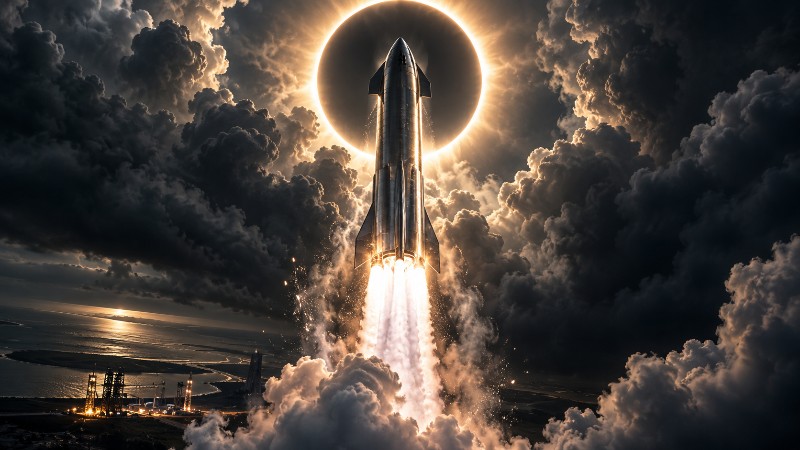
On September 28, exactly eighteen years later, SpaceX will try to put Starship in orbit for the first time.
Same date. Bigger rocket. Bigger bet.
Starship has flown thirteen times. It's been to space. On recent flights, it even carried satellites. But every previous flight was suborbital on purpose, and Flight 14 is the first attempt to cross that line.
The plan: Starship will climb into orbit, circle the planet about six times, and release 26 working Starlink satellites. Then it will fire an engine, drop out of orbit, and splash down in the Pacific off Chile.
The rocket comes home. The satellites stay.
If it works, Starlink gets faster. And something else happens: the timeline for putting data centers in space gets a lot shorter.
Let me explain.
The Short Version
You know the story by now. AI runs on electricity, and the grid can't keep up.
The country's biggest grid operator has come up short in its last two power auctions. That had never happened before. New York hit pause on new mega data centers. Here in Ohio, Lima just banned them for 18 months, and there's a push to put a statewide ban on the ballot.
Big Tech plans to spend more than $660 billion this year. Much of it will sit waiting for a plug.
So here's the wild idea. Put the data centers in space.
Up there, the sun shines almost nonstop. No utility. No zoning board. No neighbors complaining about the hum.
It sounds like science fiction. A research firm called Mach33 ran the numbers. They spent seven months pricing out every piece: the solar panels, the cooling, the chips, the launches.
Their conclusion: somewhere between 2029 and 2032, building computing power in orbit gets cheaper than building it on Earth.
By 2029, a space data center beats what Nvidia CEO Jensen Huang says an Earth-based one costs. By 2032, it beats even the cheapest estimate on Wall Street.
Why? Earth keeps getting more expensive. Land, power lines, cooling, permits, protests, concrete—all of it climbs about 7% a year. Rockets keep getting cheaper.
Elon Musk thinks it all happens faster. He says the first AI satellites launch late next year, with "significant scale" in 2028. The skeptics say the 2030s.
Mach33 lands right between them. That's usually where the money is.
The Only Company With All Four Keys
To win this race, you need four things: cheap rockets, customers, a way to build the hardware, and a mountain of cash.
SpaceX has all four.
It owns the rockets. It owns the network. It owns basically everything. Nobody else can say that.
Rival Starcloud has filed to launch 88,000 satellites. SpaceX has asked permission to launch up to a million.
A million satellites need a million sets of solar panels, cooling radiators, and laser links. Somebody has to build all that.
Mach33 expects SpaceX to finish rolling out its new Starlink satellites around 2030. After that, it needs a new job for its rockets and a new place to put its cash. Space data centers show up right on schedule.