Iran’s Bitcoin Tollbooth

Posted April 09, 2026
Chris Campbell
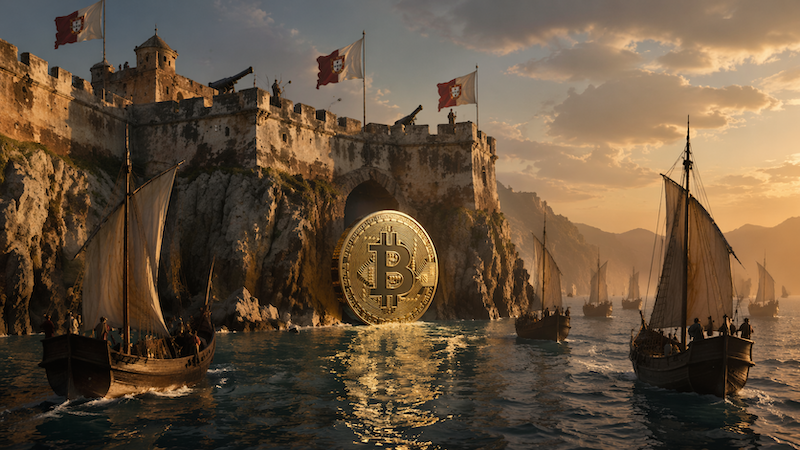
In 1507, Portuguese explorer Afonso de Albuquerque sailed into the Strait of Hormuz with cannons and a plan.
The local ruler took one look at the guns and signed a tribute agreement. Albuquerque declared victory and sailed away.
But then the tribute stopped coming.
So in 1515 he came back with 27 ships and 2,200 men.
This time he built a fortress and invented a document called the cartaza—paid permission to transit the Strait.
No cartaza? No passage. Pay up or get seized and destroyed.
Any unlicensed ship, particularly Muslim-owned, was subject to seizure and sinking.
Portugal collected that toll for 107 years.
The racket only ended in 1622 when Shah Abbas of Persia cut a deal with the English East India Company—commercial rights in exchange for firepower—and the two of them threw the Portuguese out together.
… Welp.
The cartaza is back.
But this time, it’s connected to Persia’s Bitcoin wallet.
“Pay Me in Bitcoin”
The Financial Times got the scoop.
An Iranian official, Hamid Hosseini, told the FT: vessels have "a few seconds" to pay in Bitcoin, "ensuring they can't be traced or confiscated due to sanctions."
Separately, the FT obtained a radio broadcast transmitted to ships in the Gulf. In English.
"If any vessels try to transit without permission, [they] will be destroyed."
Hosseini is a spokesperson for Iran's Oil, Gas and Petrochemical Products Exporters' Union.
Here's how it works: ship operators submit vessel details to an IRGC-linked intermediary via email.
Approved vessels get a one-time permit code and routing instructions along the Iranian coastline—met by an Iranian patrol boat and guided through Iranian territorial waters.
Payment comes next.
The rate: $1 per barrel. A fully loaded supertanker holds two million barrels.
That's a $2 million toll per ship, payable in Bitcoin.
The Portuguese called it a cartaza. Iran calls it a transit fee. The math is the same. Even if the tech has changed.
Bitcoin was designed to be neutral infrastructure.
It doesn't care who uses it or why. That’s the source of its value.
Every coin has two sides.
The Hormuz toll is one. The dissident in Tehran who can still access their own money is the other.
Will it Actually Work?
Turns out, the system has been operational since mid-March.
Iran advanced the "Strait of Hormuz Management Plan" on March 30-31, codifying something already running.
Andrew Fierman, head of national security intelligence at Chainalysis, called it "highly unsurprising"—the IRGC had already run $178 million in crypto through a single oil-for-Yemen network in one year.
Hormuz is just the latest application of existing rails.
The compliance trap for Western operators is real—paying an IRGC-linked wallet is a potential OFAC violation regardless of whether cargo moves.
Most shipping executives say they have no contact with Iranian authorities and no clarity on the process.
But, of course…
Western operators aren't the target market.
The system is built for Chinese, Indian, and Pakistani flagged vessels—counterparties who scoff at OFAC and aren't running their payments through US correspondent banks.
Iran has a five-tier nationality ranking system. Friendlier nations get lower rates. US and Israeli-linked vessels are denied entirely.
The Wall Street Journal reported Iran told mediators it would limit transit to roughly 12 ships per day.
Pre-war was 120-138.
Even so, the revenue—estimates suggest up to $20 million per day from oil tankers alone, $600-800 million per month if LNG vessels are included—is secondary.
The primary product is the demonstration that Iran controls the Strait.
That, to Iran, is worth more than the Bitcoin.
Cartaza 2.0
Portugal ran its cartaza system for 107 years.
It only ended because a rival coalition—Persia plus England—assembled enough combined force to physically remove them.
So, the question: will the toll hold?
Mark Nevitt, former Navy commander and Emory law professor, wrote this week that Iran has "shown no sign of losing its capacity to control the Strait."
The White House said any toll violates the ceasefire terms. Then Trump, jarring as ever, told ABC News he was open to a "joint venture" with Iran to co-manage them. Iran halted traffic again within hours, citing Israeli strikes on Lebanon.
Meanwhile, a reported 800 vessels sit anchored in the Persian Gulf.
In 1622, Persia ended the toll. In 2026, Persia runs it.
The chokepoint never changed.
Everything else did.