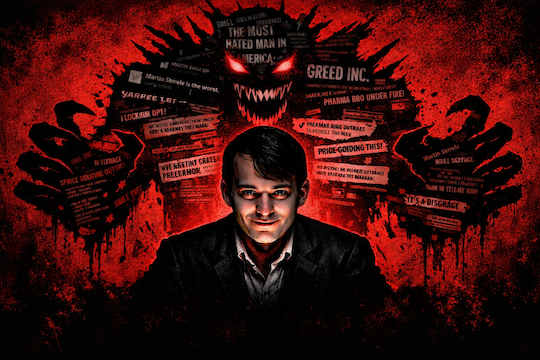
Martin Shkreli: Confessions of the “Most Hated Man”
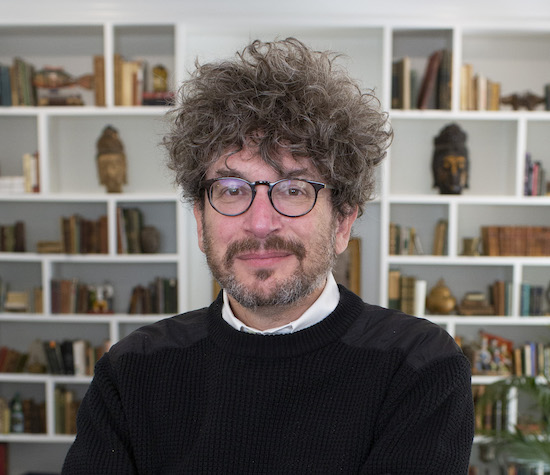
Posted February 26, 2026
James Altucher
It’s one of my most controversial podcasts ever.
Recently, I sat down with Martin Shkreli.
Most know the caricature: the smirking “pharma bro” who raised a drug price 5,000%, got arrested, went to prison, and never once apologized.
The "most hated man in America," as some in the media crowned him.
I've been on the receiving end of media backlash, though nothing close to what Martin experienced.
And I'll admit it got to me more than maybe it should have.
Martin was able to take the blows and turn them into a positive force in his life.
I asked him how he built that armor.
His answer: conviction.
Before I get into what he means by that—and how anyone can use it to eat the dragon and keep the fire—let’s back up.
Because the version of Shkreli most people think they know is a headline, not a biography.
The Daraprim Story
Here's what happened that got him into hot water:
In 2015, through his company Turing Pharmaceuticals, Martin acquired Daraprim, a drug treating toxoplasmosis.
Daraprim was an old, off-patent drug from the 1950s with no generic competition and minimal revenue, selling for $13 a pill.
Shkreli raised the price to $750—and the backlash was immediate.
But, he said, patients didn’t pay that list price. Insurance did. Uninsured patients received the drug for free. No one went without treatment.
Also, the drug had been economically abandoned.
When a medicine generates trivial income, no one invests in monitoring resistance, upgrading manufacturing, or improving distribution. By raising the price, he could turn a neglected asset into a viable business with incentives for stewardship and oversight.
The outrage was selective.
Drugs priced at $1 million per treatment exist in the U.S. with far less public fury directed at their CEOs.
He argues that politicians (including Hillary Clinton) either misunderstood the reimbursement system or exploited public anger.
The Big Bad Wolf Effect
The government couldn't get Martin on the drug pricing—because there was nothing illegal about it.
Instead, in 2017 he was convicted on securities fraud and conspiracy charges tied to earlier hedge fund activities and his biotech company, Retrophin.
The drug pricing controversy made him infamous. The securities case sent him to prison.
Martin believes the two stories were not as separate as they appeared.
He points out that the Southern District of New York has one of the highest conviction rates in the country and argues that once someone becomes a national symbol—the “Big Bad Wolf,” as he calls it—incentives shift.
He chose to fight the charges rather than accept a plea.
What Prison Taught Him
Martin spent four years inside.
He rejected the idea that he “lost” years.
He read hundreds of biographies. He studied crypto. He got deep into software. He also spent real time growing closer to his father, who later died relatively young from heart problems.
"I wouldn't say I lost those four years," Martin told me. "I had a different four years."
That reframe is everything.
When he came out and joined a Twitter Space talking about crypto, some of the most famous investors were listening and asking each other: how does this guy know so much about our field after being locked up?
The answer: curious people never stop learning. Incarceration just removed the distractions.
Curiosity as a Superpower
Martin and I are working together right now on quantum and optical computing—fields neither of us trained in formally.
This discussion led to one of the best insights of the podcast.
His philosophy: you have to get into the weeds.
You have to be unafraid of the scary-sounding word, the intimidating equation, the field that seems impenetrable.
The second you say "let someone else handle the technical stuff," you've put artificial limits on your abilities.
Experts are essential—but you have to be able to have a real conversation with them, ask smart questions, figure out how to know when and if they're wrong.
Martin had a chemist on his team who was a postdoc under the only person to win two Nobel prizes in chemistry. He didn't try to out-chemist that guy. He just needed to understand enough to talk to him.
I shared my own version: six years of nightly stand-up comedy.
I never became a legendary comedian.
But the hours transferred—my public speaking got 1,000x better. The skill of learning transfers across domains.
That's the thing most miss.
The Value of Conviction
Shkreli was wrong about some things—he admitted as much.
His PR strategies backfired. His Twitter provocations had consequences.
Standing your ground works better when you're also occasionally strategic about how you stand it.
But for Shkreli, conviction is survival.
And it’s as essential in business as it is in public life.
In investing, if you don’t believe in your analysis, you panic at volatility and sell at the worst moment. In leadership, if you don’t believe in your decision, you retreat at the first wave of criticism.
In controversy, if you don’t have conviction, the mob will decide for you.
He said this:
At the end of the day, the label "most hated man in America" said more about the people who wrote it than about him.
Labels are mirrors. They reflect the storyteller first.
And the louder the label, the more you should question who benefits from it.
Check out part one of our conversation here.
(Part two is coming.)