Pokémon: My Worst Investment Ever

Posted October 01, 2026
Chris Campbell
I hate Pokémon.
And it’s for all the wrong reasons.
I was one of those kids. In 1999, I’d spend weeks scraping together $5 to buy another shiny new pack. I did chores. I sold my old toys. I’d come up with clever side hustles.
Once I stuffed paper towels into the local soda machine's coin return. Then I’d come back about six hours later with pliers. It was a steady income. Low overhead. (Until everyone caught on.)
All of that money went into Pokemon.
I had the good ones too. Charizard. Venusaur. Mewtwo. Blastoise.
I loved those cards. I sleeved them. I guarded them like nuclear codes. I knew the market better than anyone. I’m not proud of it, but I made a kid cry over a Squirtle trade.
Where are they now? No clue.
One day they were in a binder. The next, I was in my thirties, staring at a news headline about Charizard.
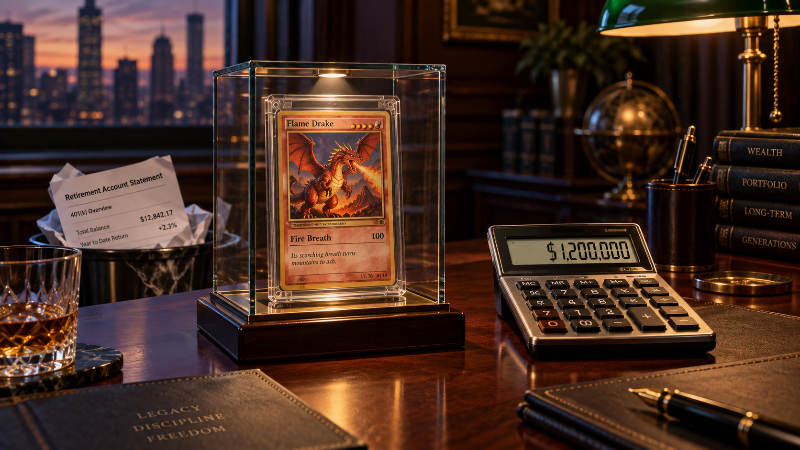
Even beat up, in a shoebox, my cards would probably be worth about $50,000 today. Perfect, at this year's record prices? Probably over $1.2 million. Maybe more.
Twenty bucks of cardboard. $1.2 million.
Seems crazy? It is.
And it all raises the question: how did a playground toy beat the stock market, and what does that tell the rest of us about how to invest?
The Numbers Are Real
Card Ladder runs a Pokémon index. Since 2004, it's up roughly 3,821%, according to the Wall Street Journal.
The S&P 500 over the same stretch? About 483%.
In 2021, Logan Paul—a YouTuber—paid $5.3 million for a single Pikachu card. In February, he sold it for $16.5 million. The most expensive trading card ever sold at auction.
This year, while Bitcoin fell, Pokémon cards rose about 30%.
So what's going on?
Three Things
Scarcity. Only so many 1999 cards survived. Kids bent them. Traded them. Lost them. Moms threw them out.
A generation made money. The kid who ripped open packs in 1999 is 35 now. Peak earning years. And what does a 35-year-old with money buy? His childhood. Boomers did the same with baseball cards and Mustangs.
The money got weird. Governments print money. People want things that can't be printed. Gold. Bitcoin. And, apparently, a Charizard.
The Only Part That Matters
Right now, there are 30-somethings retiring their parents from their childhood Pokemon cards.
It’s a thing.
And the collectors who made fortunes never planned any of this.
They bought it because it was fun. They kept it because they loved it. And because they loved it, they never sold.
In 2022, the market crashed. Some cards fell 50%. The flippers panicked and dumped. The people who loved their cards put the binder back on the shelf.
That's the edge. Discipline cracks when you're down 50%. Love doesn't even notice.
Most investors fail for one simple reason. They buy things they don't care about. Then they sell the moment it hurts.
3 Speeds of Wealth
Does that mean you should run out and buy Pokémon cards? Obviously not.
The only people getting rich are the ones who still have that old binder from middle school.
But the Pokémon Portfolio can teach you something.
Wealth runs at three speeds.
Speed One: Love. One to three percent of your money. Something you'd own even if the price went to zero. A vintage Rolex. A '59 Les Paul. A first-edition Gatsby. Buy the rarest thing you can afford to lose. Hold it forever.
Speed Two: Medium. The core. Great companies. Rental property. Dividend payers. Things you buy, hold for years, and let time do the heavy lifting.
Speed Three: Fast. The one most people never have. A small slice of money. A clear catalyst. A short clock. Get in before the news. Get out after.
Most investors only run at one speed.
The Love-only investor has a garage full of Beanie Babies and is still waiting for them to come back. The Medium-only investor checks his 401(k) once a year, sighs and waits for his 70s. The Fast-only investor has six screens, three energy drinks a day, and an account that peaked in 2021.
The best method? Running all three wisely. Love is up to you. Medium is what everyone talks about. Which brings me to the fastest “speed three” pattern Paradigm has ever published.
The Weekend Trade
Every Friday afternoon, Wall Street goes home.
Then Monday morning, news drops. Deals. Approvals. Announcements. Certain stocks explode.
It’s a pattern a lot of people notice but have no idea how to leverage.
With the help of AI, James recently found a way to play it. One trade Friday. Cash out Monday. Peak gains so far: 280%, 419% and 927%.
He calls it The Weekend Trade.
I missed Charizard. I don't plan on missing Mondays anymore.
James just recorded a quick video to show you how it works. Click here for the full explainer video.