
“Shock!”

Posted March 06, 2026
Chris Campbell
“Shock!” he wrote.
“Shock!” he wrote again, in case you might’ve missed the first one.
Don Knuth doesn't shock easily.
The guy wrote The Art of Computer Programming—a multi-volume monument to human intellect he's been building since the 1960s.
He won the Turing Award in 1974, the closest thing computer science has to a Nobel Prize.
He's seen everything. Done most of it himself.
So when he posted he was shocked by what an AI model just did, I stopped scrolling.
First, before we go into what just happened, consider where we are.
While one genius is marveling at what AI can do for his profession, lawmakers in New York are racing to make sure you never benefit from it.
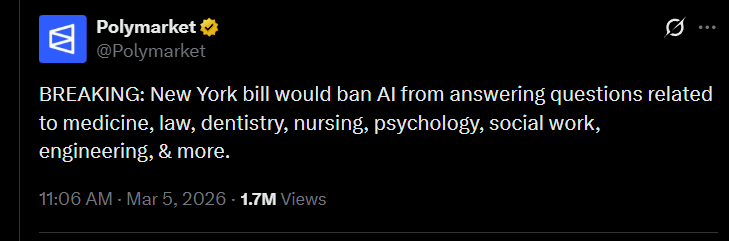
(This will undoubtedly blow up in their faces. But more on that next week.)
The Problem Nobody Could Crack
Don Knuth is 88 and still writing The Art of Computer Programming.
He needed to solve a puzzle for a new chapter—the kind of elegant, devilish problem the book is famous for.
The puzzle: find not one, but three interlocking paths through a 3D grid—each visiting every point exactly once, each returning to where it started. Then prove it works no matter how big you make the grid.
Here's why nobody had cracked it: the combinations don't just get large. They get astronomical.
Literally.
On even a modest grid, that's more possibilities than atoms in the observable universe. You can't brute-force your way through that. You need a rule—a clean, generalizable construction that works at every scale.
Nobody had found it.
Then he handed it to Claude.
A New Kind of Partner
In short, Claude solved an open problem in mathematics that legends in the field got stuck on.
In an hour. On attempt 31.
That's new.
That's never happened before.
And if you're paying attention, it changes what you think the next ten years look like—for every field where hard problems have been sitting unsolved.
First, here's what this isn't…
It isn't a story about AI replacing mathematicians. Claude needed Knuth’s deep knowledge the whole time—redirecting it when it got lost, reminding it to document its progress, restarting sessions after errors.
The AI found the door. The human kicked it open properly.
But here's the truly shocking thing: Knuth had been stuck. A problem he couldn't solve—a problem he needed to solve to finish his life's work—got unstuck in sixty minutes.
Knuth's response said it all: "What a joy it is to learn not only that my conjecture has a nice solution but also to celebrate this dramatic advance in automatic deduction and creative problem solving."
When the man who literally wrote the book on algorithms says that, you pay attention.
Unlocking the Impossible
We're entering a period where anyone can use these models to solve previously unsolvable problems… big or small.
Everyone’s an expert on something, even if they don’t realize it.
The expert (you) knows which problems matter. The AI attacks them at inhuman speed. Together, they cover ground that neither could alone.
The models are getting better.
They can work longer, dig deeper, and iterate faster than any human alive.
The question is: what problem are you going to bring to the table?
You don't need to be Don Knuth. You just need to know which door is worth kicking in.
That’s the edge.