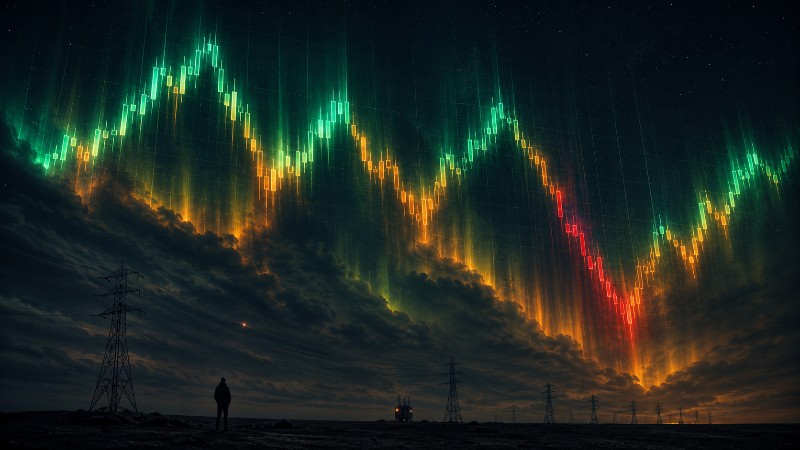
Space Blues: The Fed's Forgotten Warning

Posted July 08, 2026
Chris Campbell
Wrecked sleep. Headaches. Fog. The room tips when I stand.
Maybe you've felt it too this week.
Sure, it could be the three-day weekend I used all of. Could be the cookout food. Could be all the coffee today too—cup six was a cry for help.
Could be.
But last time I felt this way, solar storms were rolling over the planet. So I checked.
Sure enough—it's happening again.
As you read this, there's a hole in the sun's magnetic field, pouring solar wind straight at us. A fresh stream of charged particles, already on its way, here within a day or two.
We took the first hit over the July 4th weekend.
None of it made the evening news. The market didn't pause to note it.
And yet researchers estimate 10 to 15% of people feel these storms in their bodies—one in seven. In a country of 340 million, that's some 40 million Americans.
What follows is the strangest thread I've pulled in a while: from the brain fog, to a buried Fed study, to the machines that took over the market, to the grid, to the companies that could profit when the sun turns violent.
Stay with me.
Playing the Field
In 2003, economists Anna Krivelyova and Cesare Robotti published a paper for the Federal Reserve Bank of Atlanta.
They called it "Playing the Field."
The thesis: stocks fall after solar storms. Their evidence spanned dozens of countries and three decades of trading.
Here’s what they found…
In the week after the Earth's magnetic field takes a beating from the sun, stock returns come in lower. Reliably. Across the world index and almost every national market they tested.
The number for the Nasdaq was the one that stuck. Sort the calendar into stormy weeks and quiet weeks, and the gap between the two ran to roughly 14% a year.
Fourteen percent.
From weather that happens 93 million miles away.
Now—a working paper from a regional Fed bank is not scripture. Everybody knows that.
But this one had teeth, and it forced a question: Why would space weather touch the tape at all?
Space Blues
Geomagnetic storms mess with people. That’s the part the science has known for a long time.
When the field gets disturbed, sleep suffers. Melatonin production goes sideways. Anxiety climbs.
In 1994, a psychiatrist named R.W. Kay went through hospital records and found admissions for depression rose sharply in the weeks after major geomagnetic activity—on the order of a third higher in his sample.
Cardiologists have their own version of this file. Heart attacks and strokes seem to tick upward during the worst storms.
The leading theory points to the autonomic nervous system, the part that runs your heart rate and your stress response.
You don’t feel any of this as "space weather."
You just wake up flat. The coffee doesn't land. The market looks a little more dangerous than it did last week. So you trim the position. You pass on the risky trade. You move toward cash and tell yourself you're being disciplined.
Psychologists have a name for this.
They call it misattribution of mood.
You feel bad for reasons you can't see, so your brain hunts for a reason it can see. And the blinking red numbers on the screen volunteer for the job.
Multiply that across millions of nervous systems all tuned by the same star, in the same week, and you get a measurable drag on prices.
That was the argument. And for thirty years of data, it held.
Then… It Stopped.
A few years back, a researcher at ETH Zurich ran the numbers again.
For the original window, 1972 through 2000, the effect held up beautifully—a gap of better than 15% between stormy and quiet stretches, right in line with the Fed paper.
Then he extended the data past 2000.
The effect flipped. Stormy weeks were the ones with higher returns.
So which is it?
Maybe the whole thing was a mirage that survived thirty years by luck. Maybe the market wised up—anomalies have a way of dying once they get written down in a paper.
Or…
Maybe the mood effect is real, but easily buried under the algorithms, passive flows, and the machines that now trade in microseconds and feel nothing at all.
I lean toward the last one. The biological story is too well-documented to dismiss, but too weak to trade on your own. It’s a mere whisper in a room of machines that got a lot louder after 2000.
The machines, in other words, replaced the mood. But the machines aren’t entirely immune, either.
The Prettier the Sky
The machines pull from the grid. They stamp every trade against GPS time, clocked to atomic standards the regulators demand down to the microsecond.
They speak through satellites. A moody trader costs you a few basis points. A few blown transformers can shut down a town. And all of these are vulnerable to solar storms.
So rather than outrunning the sun, the market wired itself deeper into everything a solar storm can break.
There’s a reason I’m bringing this up now…
Solar Cycle 25 hit its peak in October 2024. The crowd reads that as the danger passing. The crowd has it backwards.
The most violent storms of any cycle tend to come on the way down—one to three years after the top. 1859. 1921. The Halloween storms of 2003.
All of them fired late.
Which puts the next couple of years squarely in the window.
So this weekend, when the aurora drops down to Texas and every phone on the block is aimed north, the crowd is watching the show.
Meanwhile, the exposure sits in the dark behind them—the substation, the timing signal, the bird in orbit. The prettier the sky, the harder everyone's looking the wrong way.
And with an already-stressed grid, there are a few plays you might want to put in your back pocket.
More on those tomorrow.