SpaceX, Starlink, and Mick Jagger

Posted June 10, 2026
Jim Rickards
On one of my Concorde trips between London and New York, my seatmate was Mick Jagger.
We had a nice chat.
The celebrity quotient on the Concorde ran high—CEOs, government officials, athletes, rock stars.
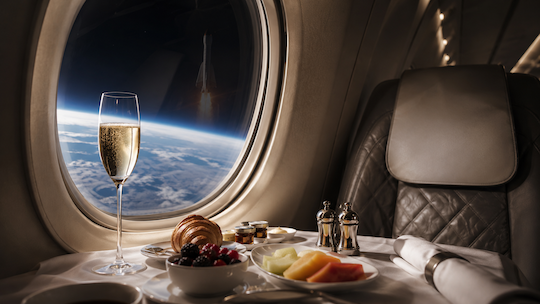
I've never been to space, but I've come close. In the 1980s I routinely flew at 62,000 feet at Mach 2.1, near the edge of space. Look up and the sky went black—you were staring into space. Look down and the curvature of the earth was visible, something you can't see at the 40,000 feet where airliners cruise.
When I mention this, people assume I was a fighter pilot or a U-2 operator. No—I earned those altitude and speed chops as a passenger on the Concorde.
The Concorde flew from 1976 to 2003. I rode both the British Airways and Air France versions. We called the Paris-New York leg the "three breakfast" flight: breakfast in Paris, another aloft, a third on arrival in New York. The trip ran 3 hours 20 minutes across six time zones, so you landed before you took off by local time.
Forty years ago I crossed the Atlantic in just over three hours. Today it takes about eight. What happened to supersonic flight?
The same question fits moon landings.
I watched—with 650 million others—Neil Armstrong's first step on July 20, 1969, then Buzz Aldrin's, while Michael Collins orbited above in the Apollo 11 command module. Five more landings followed. The program ended in 1972.
Twelve men walked on the moon; only four are still alive.
Soon none will be.
Why no return in over 50 years? Artemis recently circled the moon but didn't land. We aren't short on technology—it's better than ever. We've been short on money (though we find trillions for forever wars) and willpower.
Democrats like Clinton, Obama and Biden favored social programs over space. Republicans like both Bushes favored tax cuts and wars. Trump's first term was hamstrung by the Russiagate Hoax and opposition from Nancy Pelosi and RINOs like Paul Ryan.
Now, in Trump's second term, the lethargy is gone.
Space is back on the front burner—and this time the effort is privatized. It's a classic public-private play: private players supply the capital and technology while the government hands out contracts for NASA missions and classified Pentagon work.
The leader, of course, is Elon Musk.
SpaceX is set to IPO this Friday, on June 12. Based on his stake, Musk is on his way to becoming the first trillionaire.
SpaceX plans thousands of giant Starships with reusable boosters. Bigger payloads plus reused boosters could cut the cost of putting a kilogram in space to $185—1% of the historic price.
But that's just the start.
Cheap payloads, free energy, vast compute, space-based internet, sheer scale—Musk could become a monopolist of AI, energy and the internet. Everyone from Google to Anthropic and OpenAI would pay him rent to tap the energy-data nexus.
Plenty could go wrong. That's a day's work for Musk, who solves new problems with the same engineering prowess that got him here. His creed: anything is possible short of defying physics.
Meanwhile, the competition lags.
OpenAI's Sam Altman is skeptical of the whole vision. Richard Branson's Virgin Galactic hasn't broken through since a 2014 capsule explosion killed its co-pilot. Jeff Bezos has Musk's money and ambition but trails on technology—Blue Origin's New Glenn exploded recently in a launch-pad test, with no injuries.
The real way to play it is the fleet of smaller players who will prosper as subcontractors and suppliers.
Yesterday—Tuesday—James Altucher, Enrique Abeyta and I went live for our SpaceX SuperIPO Summit, and we named names: seven space stocks positioned to ride this effort, plus exactly what to do before the IPO prices Friday. If you weren't in the room, the replay is up now.
Click here BEFORE June 12 to learn exactly what to do before the bell.