
Tesla Tips its Hand

Posted June 25, 2026
Chris Campbell
Yesterday, the official Tesla Optimus account posted a job listing on X.
The headline: "Hand jobs available."
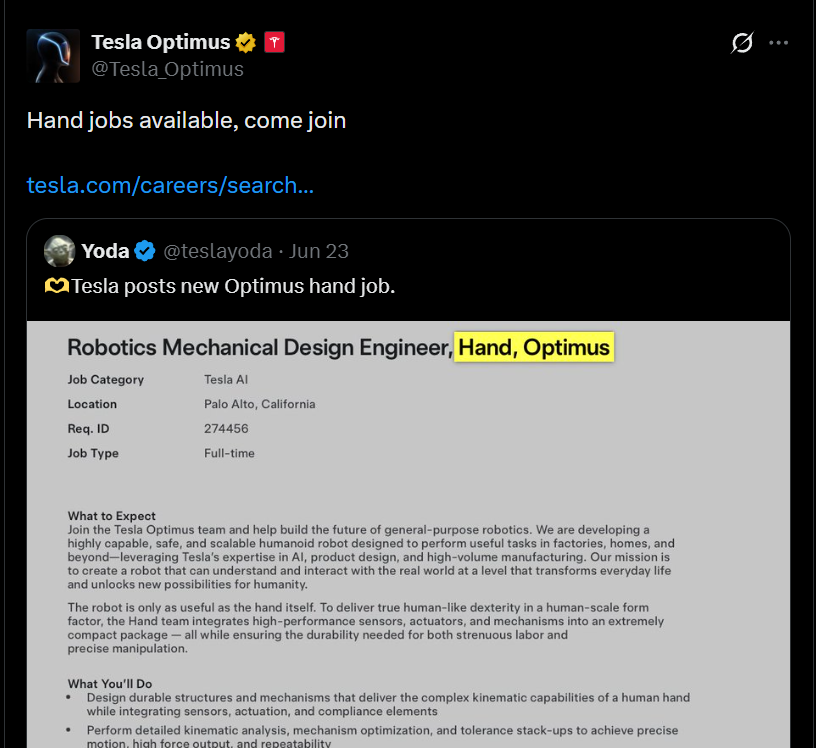
The internet did its thing. Jokes. Screenshots. Forty thousand people pretending to be twelve years old.
Fine. Funny. I laughed too.
But underneath the joke is a tell. And almost nobody caught it.
Tesla’s begging for engineers to work on one specific part of its robot. Not the legs. Not the brain. Not the cute face.
The hand.
And the reason they're desperate for these engineers is the reason you're reading this right now.
Because the human hand—the one you're using to scroll right now—is one of the most staggering pieces of engineering in the known universe. We just never notice, because we've had ours since birth.
Let’s take a moment to notice.
By the end of this, you'll never look at your own hand the same way. And you'll understand why it's one of the single most important things to watch in the entire humanoid robot story—and where the quiet money will be hiding.
The Grip That Built Civilization
Hold up your hand. Wiggle your fingers.
You just commanded roughly 27 degrees of freedom—27 separate dials your brain can turn at once—using around 30 muscles, most of which aren't even in your hand.
They're up in your forearm, pulling your fingers like a puppeteer working marionette strings through tendons. That's why your forearm is thick and your fingers are thin. Evolution put the motors upstream and ran the cables down.
Now the even more impressive thing…
Your fingertips are wired with thousands of touch receptors per square inch. They can feel a bump the height of a single sheet of plastic wrap. They can tell silk from satin in the dark.
When you pick up a paper cup of coffee, you’re running a live physics calculation without realizing—grip it too soft and it slips, too hard and it crushes, and you solve that equation in milliseconds without a single conscious thought.
You can thread a needle. Crack an egg. Find your keys in a bag by feel alone. Feel a fever on a child's forehead. Type 80 words a minute. Play a piano. Tie a knot behind your back.
A quarter of the motor cortex of your brain—a quarter!—is devoted to running your hands. Your brain decided your hands were so important it gave them an enormous share of its real estate.
And we’re glad it did…
We built the entire human world with these things. Every cathedral, every circuit board, every surgery, every meal. And we treat them like they're nothing, because they cost us no effort.
That effortlessness is the illusion. Underneath it sits the most sophisticated manipulation system nature ever produced.
Now Try to Build One
That’s where it gets humbling.
Elon Musk—a man who lands rockets on their tails and is not known for underselling his own difficulty—has said the robot hand is roughly 60% of the entire challenge of building the Optimus robot.
Industry analysts estimate the hand alone can be up to 25% of a robot's entire bill of materials, and rising. It's the densest concentration of motors, gears, screws, sensors, and magnets anywhere in the machine.
Look at what Tesla had to do just to approximate your hand:The newest Optimus design has 22 degrees of freedom in the hand—still short of your 27. To get there, Tesla copied your body almost exactly.
To make the tendons pull, they need around two dozen tiny motors per arm, miniature gears, and a fistful of precision screws the size of your pinky nail that turn spin into pull.
Then they have to wrap the fingertips in artificial skin—custom touch sensors—so the robot can feel grip the way you do.
And after all of that, the early versions still wore out fast.
Reports say some of these hands lasted only a few hundred hours before breaking, against an industrial standard of a couple thousand. The fingers were the first thing to fail.
That's the whole story in one image: the company that can build a self-driving car and a reusable rocket got beaten by the thing you just used to fish the last chip out of the bag.
Watch the Hand
If you only track one piece of this robot revolution, track the hand.
A humanoid robot that can walk but can't manipulate the world is a very expensive mannequin.
The entire promise—folding laundry, loading machines, caring for the elderly, cooking, building—lives or dies on the hand. A humanoid robot is only as useful as what it can do with its fingers.
And the hand is where the most expensive, most difficult, least-available parts pile up.
In short, it's the bottleneck. And bottlenecks are where the money pools, because everyone building a robot has to buy their way through the same narrow gate.
Tomorrow, we'll go deeper into the hand than anyone else will. Past the fingers, past the parts, down to the sectors nobody's thinking about—the bottlenecks inside the bottlenecks inside the bottlenecks.
Best part? They'll win even if humanoids never even work out.
And you’ll see it here first.