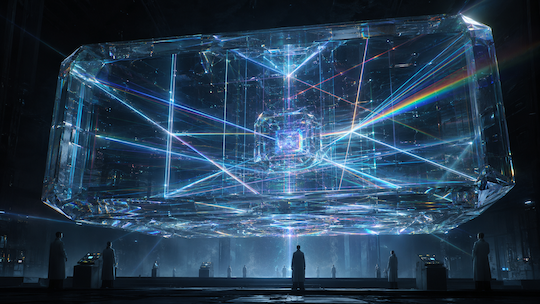
The Death of Electronics

Posted May 21, 2026
Chris Campbell
Your computer runs on a dying idea.
The idea is electrons.
Push them through wires fast enough and you get a funny thing called computation.
And it was a good idea.
It worked for sixty years. It built transistors, Moore's Law, and a fistful of trillion-dollar companies that print money by selling sand that thinks.
BUT… the trick is now failing.
The Problem? Physics.
Computers basically stopped getting faster about fifteen years ago—and the parts inside are now so small they're only a handful of atoms wide. There's nowhere left to go.
You cannot etch a wire thinner than an atom, and well before you get close, quantum physics walks in and refuses to cooperate.
So engineers found a workaround. If one chip couldn't go faster, bolt several together and split the work. It helped—but it's a patch, not a fix.
Crack open a modern chip and most of it isn't even doing the thinking. It's just storage, sitting there waiting.
The whole machine has become an elaborate workaround for a problem nobody likes to say out loud.
Here's the real problem: energy.
Laid out simply:
Every new AI model is bigger than the last. Every bigger model needs more compute. More compute needs more power. The curve points straight up, and it doesn't ask permission.
The demand projections are so large, data centers are now shopping for their own nuclear reactors.
Power plants take a decade to build. A nuclear reactor takes longer. Demand is sprinting and supply is crawling—and that gap is the ceiling.
Walls like this don't fall on their own.
They need a few stubborn engineers willing to look stupid in public.
But they’re out there. And what they found is the rare kind of breakthrough you can actually put money on.
The Solution? Light.
The idea is heretical and simple. Stop computing with electrons.
Compute with light.
AKA, photonics.
Maybe you’ve heard this before.
But consider why it’s not that crazy…
The internet already runs on light. Fiber optic cable under the oceans, fiber running into your house, all of it photons. We move information as light right up until the second we want to use it. Then we convert it to electronics, compute, and convert it straight back.
The heresy is asking why we bother with the round trip. Why not compute in light directly.
The Good Part? It’s Cheaper.
Light has advantages electrons can only envy. No resistance, so almost nothing wasted as heat. And light comes in colors.
Fire red light and blue light through the same chip at once and they ignore each other entirely. Two calculations, one cycle, zero interference.
Try that with electrons and you get noise.
There's a catch, of course. Light is fatter than an electron. Photonic chips need bigger features, which means fewer logic gates per square inch.
That sounds fatal. It isn't. Bigger features mean photonics can skip the bleeding-edge fabs and use the older, cheaper foundries.
The chips run slightly larger, dramatically faster, and noticeably cheaper.
Every piece can be built on home soil, which—in a world that keeps reminding us how fragile supply chains are—counts as an asset all its own.
Here's the part you actually care about. How do you make money on this? The hard part.
The Hard Part? Memory.
Light hates to stop.
It wants to keep moving forever, which is lovely in a poem and maddening in a computer. But a computer needs to stop and remember things. Storing light—the engineers call it "photonic memory"—is the hard, unsolved part.
Whoever cracks it wins enormous.
The work is underway.
When light-based computing shows up, it will be starving for memory fast enough to feed it.
But the name to know sits on both walls at once: Astera.
James and I met the team from Astera Labs at Nvidia's GTC and pointed them out during our live event.
Astera builds the connective tissue between fast computers and slow memory—and it's been buying its way into optical hardware too. Moving light, clearing the bottleneck—one company, both bottlenecks.
We've kept it on the list ever since. (Up 81% since we talked about it live in March.)
Astera too boring? Want a lottery ticket?
Look at the tiny firms chasing the exotic materials and photonic memory itself. Small, public, binary. They solve it and soar, or they vanish. Small position. Eyes open.
Here’s the whole thesis, in a nutshell:
Computing is shifting from electricity to light, because electricity got too hot and too expensive to scale. The two BIG problems are heat and memory.
Buy a shovel-seller for safety. Preferably, own a company that plays both problems at once. Feeling froggy? Take a small swing at the moonshot.
Electronics had a good run. The next one belongs to light.