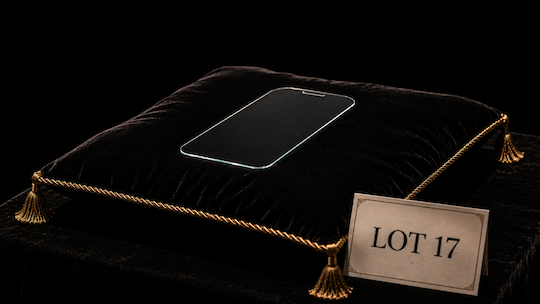
The Gorilla Glass Trade

Posted June 02, 2026
Chris Campbell
"Do you know what your problem is? You're afraid. You're afraid I'm going to launch the biggest product in history... and I'm going to eviscerate you."
Six months before launch, Steve Jobs was carrying the future of Apple in his pocket.
And it was getting scratched to hell.
He'd been keeping a prototype iPhone in his jeans next to his keys. When he pulled it out, the plastic screen was a web of scratches.
Jobs was livid.
He told his team the iPhone would ship with real glass—or it wouldn't ship at all. The engineers pushed back. Glass shatters. Glass adds weight. Nobody put glass on a phone in 2007. There was a reason for that.
Jobs didn't care. He'd already found his man.
Wendell Weeks ran Corning—a 150-year-old company known for fiber optics and the Pyrex in your grandmother's oven. And Weeks had something strange in the vault.
Back in the early 1960s, Corning chemists had invented a nearly unbreakable glass. It came out of a research moonshot named "Project Muscle."
You could throw it across a room and it wouldn't break. But nobody wanted it.
Corning pitched it for windshields, for phone booths. The market yawned. The glass sat untouched for forty years—a brilliant answer to a question no one had asked.
Then Jobs asked it.
“You’re Afraid”
At first, Weeks shot him down: Corning didn't make this glass at scale. The deadline was impossible. His own board wanted to send Apple packing.
Jobs leaned in.
"Do you know what your problem is? You're afraid. You're afraid I'm going to launch the biggest product in history... and I'm going to eviscerate you."
Build it now—or spend the next decade explaining why you didn't.
Weeks folded.
Corning took an old Cold War-era plant in Harrodsburg, Kentucky and flipped it to glass production in weeks. No multi-year ramp.
By the time the iPhone shipped in 2007, Corning had made enough Gorilla Glass to cover seven football fields.
That one move turned a forgotten science experiment into one of the most widely used materials on the planet.
Now here's why I'm telling you a glass story in 2026.
Because it's happening again. Right now. With a couple of public companies nobody’s heard of.
The Gorilla Glass Trade
On Monday, June 8, Apple takes the stage at its developers conference WWDC.
The company everyone spent three years calling a dinosaur—the one that "missed AI," the one OpenAI and Google lapped while Siri sat there dumb as a brick—is about to make its move.
Here’s the thing about Apple…
Apple is ALWAYS late.
Late to MP3 players—then the iPod took 75% of the market. Late to phones—Ballmer laughed, "no chance." The iPhone is now the best-selling phone on Earth. Late to tablets. Late to watches. Late, late, late.
This time is no different.
Apple doesn't need to invent the smartest AI. It needs to put AI in your hand—and it already owns the hand. 2.5 billion active devices.
Which brings me back to the glass.
Apple won't build every piece of this AI future itself. It can't—same as it couldn't invent unbreakable glass in 2007.
It needs suppliers. The chips, the silicon, the hardware that turns "AI on your phone" from a keynote slide into something that runs in your pocket without melting the battery.
Recently, our team spotted what we believe is the next Gorilla Glass, but for AI. A company sitting on exactly what Apple needs, at exactly the moment it needs it.
Most will miss it. Those who don’t miss it, will probably just buy Apple and call it a day. They'll never hear the name of the small suppliers whose entire business is about to get swallowed by 2.5 billion devices.
(Until it really is too late.)
That's what James has been digging into.
And that’s why, despite everything else happening in the markets, we believe you should pay attention to what’s coming on June 8—when Apple holds its largest event of the year: WWDC.
James reveals everything at the link below.
Click here to see what Apple’s June 8 announcement means—and the companies behind it.