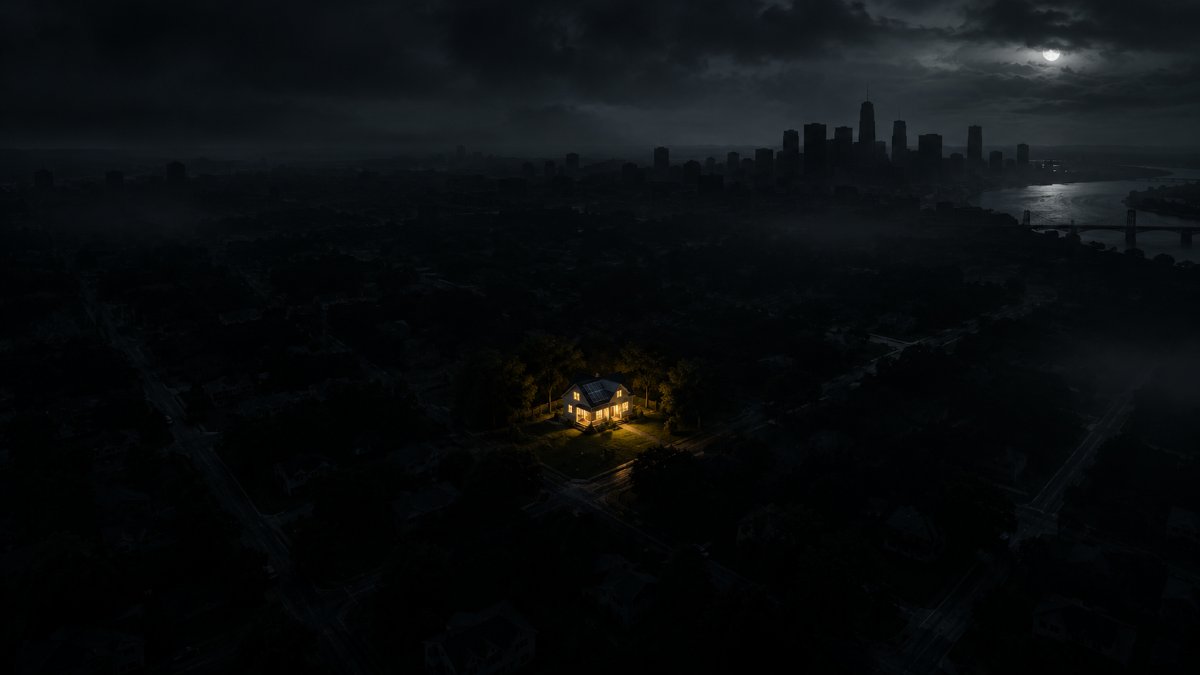
The Prepper’s Wager

Posted November 18, 2026
Chris Campbell
Turning and turning in the widening gyreThe falcon cannot hear the falconer;Things fall apart; the centre cannot hold;Mere anarchy is loosed upon the world
W.B. Yeats wrote that in 1919, right after a world war and a pandemic.
It’s never been more relevant.
Last week, one router grounded every flight in America. The falcon could not hear the falconer.
And in 2024, U.S. electricity customers experienced an average of 11 hours of electricity interruptions, or nearly twice as many as the annual average experienced in the decade before.
You can read this poem two ways: as a warning, or as a forecast.
I read it as a forecast. A hopeful one, even. And it comes with a bet attached. Every one of us is placing it right now, in some way, shape, or form.
Call it the prepper’s wager.
The Center Cannot Hold
Around 1900, Chicago businessman Samuel Insull sold America on the idea that one giant power station could light a whole city cheaper than a thousand small generators.
He was right. That same model spread to water, food, money, media and work. It made us rich.
It also made us dependent.
When the chain of wires, pipes and trucks works, you never think about it.
When it breaks, you sit in the dark and wait.
Two Choices
In 1984, Yale sociologist Charles Perrow studied disasters from Three Mile Island to airline crashes.
His conclusion: in big, tightly wired systems, “multiple and unexpected interactions of failures are inevitable.”
Sounds like last week.
Four years later, anthropologist Joseph Tainter studied why civilizations from Rome to the Maya collapsed.
Each solved its problems by adding complexity: more officials, more soldiers, more rules. Each new layer paid off less than the last, until the whole thing cost more to hold together than it returned.
So our own complex systems face two choices.
It can tighten: more rules, more layers, more automation. Every center has tried this. The bill only goes up.
For example, utility distribution spending has grown by 6%/yr since 2014 in real dollar terms, 4x faster than in the prior 20 years, and the everyday grid is no more reliable than it was a decade ago.
The second choice? Loosen. Let the edges carry the everyday load. Keep the center for the jobs only it can do.
The headlines suggest we’re tightening. Underneath, in part because of AI, the loosening is happening faster than anyone realizes.
The Center Becomes the Spare
Consider the pattern.
A hundred years ago, the iceman delivered a block to your door every few days.
Then the refrigerator showed up. The iceman disappeared. The ice plant found a new job: selling you a bag of ice before the hurricane or big barbecue. The center became the spare.
Once the everyday job gets cheap enough to handle at home, the center stops doing the daily work and starts insuring it.
It happened with laundry, phones and banking. It’s happening now with power, water, health checks, AI and work.
One example describes the trend: In the Chicago area, families can get a 40-kilowatt-hour home backup battery for just $95 up front. On hot days, the company sells power from thousands of these batteries back to the grid.
When the grid fails, the battery keeps the lights on. The grid becomes what the family falls back on. The spare becomes the center and the center becomes the spare.
The Prepper’s Wager
At this moment, all individuals and institutions are confronted with a prepper’s version of Pascal’s wager.
If the center holds and you built a backup, you paid a little for insurance. If the center cracks and you didn’t, you sit in the dark and wait. The downside of preparing is relatively small. The downside of skipping it is large. Downtime becomes more and more expensive over time.
The investment version is better still.
When the center tightens, it spends record sums on equipment and metal. When the edges loosen, they buy the same equipment and the same metal. The picks and shovels get paid either way.
Many people are making some version of the wager. They’re digging wells. Buying generators. Or building an off-grid data center. Scroll the internet and it looks like everyone is.
America has more than 35,000 cities, towns and townships. Each needs to start thinking about water, power and communications that survive the next failure.
So follow the picks and shovels. The equipment every town needs. The metal every battery needs. The companies that make the backup cheap enough to become the everyday.
Things fall apart.
Then the center becomes the spare.