
The Stablecoin Sandwich

Posted May 13, 2026
Chris Campbell
Bloomberg Television aired a feature this week on stablecoins.
The framing was cautious…
But the numbers were anything but.
(And yet, as you’ll see, they weren’t bullish enough.)
Bloomberg pegs total stablecoin transfer volume at $56 trillion by 2030.
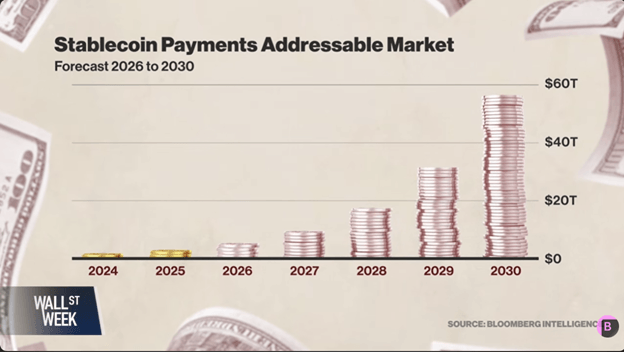
For context—Visa did about $15 trillion last year. Mastercard about $9 trillion. The entire SWIFT network handles roughly $150 trillion annually.
A handful of dollar-pegged tokens running on public blockchains will muscle their way to a third of that in four years.
Three things matter.
Where stablecoins are today. Where they're going. And what to do before the world wakes up to what’s happening.
The Wealth Transfer
Meet Hannah Nicole Dunois.
Restaurant manager in New York. Sends $500 to $1,000 a month back to her family in the Philippines.
She's one of about 2 million Filipinos working abroad who collectively wired $35 billion home in 2025—seven percent of the country's entire GDP.
A decade ago, that pipeline charged 8%.
Today it's ~2%.
Wei Zhou, the CEO of a Philippine outfit called Coins, told Bloomberg stablecoins can drop the fee to 0.5%—maybe lower.
On $40 billion in annual flow, every percentage point saved is $400 million that’s not bleeding out to middlemen.
That's a remittance cartel losing its toll booth. Right now. And barely anyone’s talking about it.
The Stablecoin Sandwich
The industry calls it a "stablecoin sandwich."
Customer in New York hands dollars to an app. The app converts to USDC. The token travels across a blockchain in seconds. On the other end, a partner converts it back to pesos. The customer never sees the crypto leg.
Easy peasy.
But here’s the part analysts are downplaying:
Matt Higginson at McKinsey told the network that 99% of current stablecoin volume is "crypto related"—traders moving money between exchanges, not grandma sending birthday cash to Manila.
Real payments volume runs $1-2 billion a day. $390 billion a year. A rounding error against the global payments stack.
True enough.
But the stablecoin supply itself doubled in twelve months—$150 billion to $300 billion. And 60% of actual payment flows already originate in Asia, not the West.
The West is running late.
When the Paint Dries
Singapore figured this out years ago. So did Japan.
Both jurisdictions wrote rules requiring stablecoin issuers to hold 100% liquid reserves against tokens in circulation, then got out of the way.
Sopnendu Mohanty—until recently the chief fintech officer at the Monetary Authority of Singapore—put it plainly: Cross-border payments are the single biggest unsolved problem in global finance. Stablecoins solve it.
In the U.S., the GENIUS Act passed last year. The rails are legal. JPMorgan, Citi, BofA—they’re all building, but none have launched.
Banks don't move first. They move together.
Zelle, 2017—seven banks, one launch day, coordinated panic about Venmo. Before that, online banking in the '90s. Before that, ATMs in the '70s.
When they move, the world's payment infrastructure changes. Sometimes literally over a weekend.
Nobody wants to be first. Nobody can afford to be last. Stablecoins are next, at ten times the scale.
$56 Trillion is Bearish
The segment ended with a Philippine bank—formerly ranked sixth or seventh—that did one thing differently…
It banked crypto exchanges when nobody else would. The same exchanges running the stablecoin remittance corridors.
It's now a top-three bank.
That's the game: the banks that adapt eat the banks that don't.
Remittance corridors retool first—they have to. Then small business cross-border. Then mid-market. Then the dam breaks.
Bloomberg's $56 trillion forecast assumes things grow in a somewhat orderly fashion.
I’m assuming they won’t.
Network transitions are almost never orderly. They're usually bigger, faster, and messier than the models predict.
Email, mobile, broadband—every analyst model lowballed the curve because they extrapolated linearly through what turned out to be a phase change.
The interesting question isn't whether stablecoins win.
It's who rules this new roost.
We have a few names in mind.
More tomorrow.