The War Over Bitcoin's $1.4M Rave Parrot

Posted August 13, 2026
Chris Campbell
It’s called Bip 110.
And, if you own Bitcoin, you should know about it. And not for the reasons you might think.
So the short version:
Last Friday, Bitcoin split in two.
You probably didn't notice. The price barely moved. CNBC never mentioned it. Though it sent many Bitcoiners into a rage… it ended in a whimper.
That's pretty much the whole story.
But again, if you have even a little Bitcoin… it’s an important story to understand.
Because you should always know what you hold.
Let me back up.
The Graffiti Problem
For years, a fight has been brewing inside Bitcoin over a simple question: what is this thing for?
One camp says Bitcoin is money. Full stop. Digital gold. The hardest asset ever created. Everything else is heresy.
The other camp treats Bitcoin more like an immutable database. The most secure hard drive ever built. If people pay to carve pictures into it, that's the free market talking. Let them carve.
And carve they did.
These carvings, by the way, are called "inscriptions." Think of them as graffiti sprayed onto the most secure wall in human history.
Since 2023, millions of them—cartoon frogs, digital trading cards, whole token economies—have been etched permanently into the blockchain. (More on them—and the infamous $1.4M rave parrot—later.)
Of course, the money camp hates it. They call it spam. Bloat. A desecration.
So they did something about it.
At least, they tried.
Enter BIP-110
A pseudonymous developer—known only as "Dathon Ohm”—proposed a rule change.
BIP-110.
It would slam the door on new inscriptions for one year. A consensus-level crackdown. The blockchain equivalent of the city council banning spray paint.
Its supporters were loud, confident, and effective. They brought a lot of Bitcoiners to their side.
But changing Bitcoin takes more than passion. It takes miners, node operators, and the businesses that move real money—all pulling the same way.
It requires them leaving the old Bitcoin and joining your new “forked” Bitcoin.
And when it came time for the network to vote… BIP-110 only got 2.53% of miners to join their network.
The most passionate faction in Bitcoin—loud on social media, righteous in their cause, backed by veteran Bitcoin developers—could only muster support from roughly one in forty miners.
It’s like seceding from America and discovering your new country is a single parking space. In Antarctica.
So why did it fail? Simple.
Economics.
The Thing About Cartoon Wizards
There’s about 127 million inscriptions carved into blocks now, totaling 33.6 GB of stored data and 4,463 BTC in cumulative fees.
And here’s the thing about the fees: All of them went to miners.
Miners who—every four years, like clockwork—watch their block rewards get sawed in half. Inscriptions were proof that something besides traders can pay Bitcoin’s security budget when block rewards go to zero.
Also… a slightly spicier take…
Say what you want about cartoon wizards: carving data into an immutable, uncensorable ledger that outlives every server, every company, every government database—that's pretty innovative.
The stone tablet of the digital age. And stone tablets have collectors.
The $1.4M Parrot
Consider this:
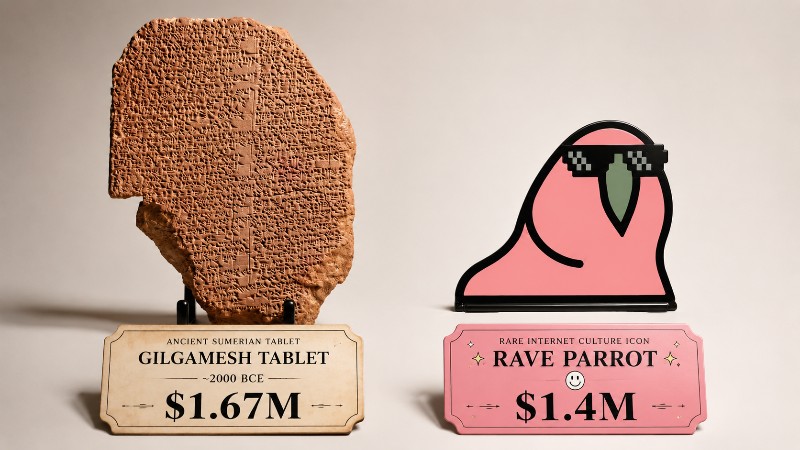
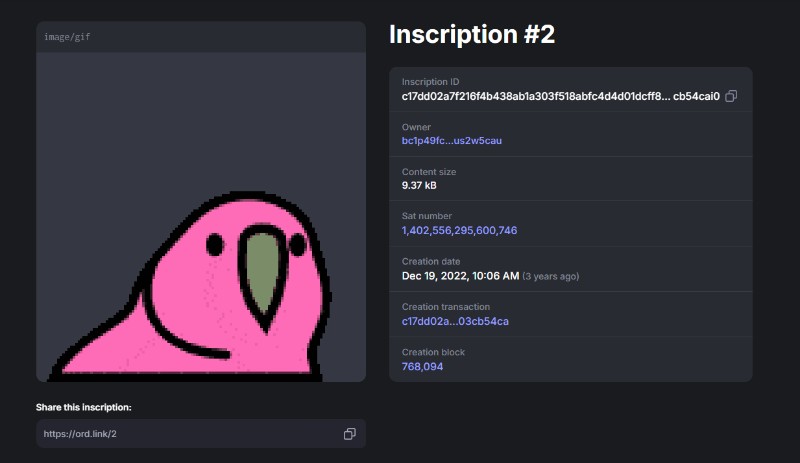
Someone paid $1.4 million (24.48 BTC at the time) for the second inscription ever made—a GIF of the rave parrot. A relic from day one inside what is likely to become the hardest civilization to erase.
At the risk of comparing apples to digital oranges…
Consider the Gilgamesh Dream Tablet, carrying a fragment of the world’s oldest epic—bought for $1.67 million in 2014.
Recall also: federal agents immediately seized the tablet. It turned out, it was looted from Iraq and laundered through dealers with doctored paperwork. The tablet went home. The money didn't come back.
The parrot, meanwhile, has no paperwork to fake. Its chain of custody is the blockchain itself—complete, public, mathematically sealed from the second it was carved.
It can’t be forged. It authenticates itself instantly. It has no jurisdiction. Its date can’t be disputed. And, no less, it can be transferred to anywhere in the world for pennies, instantly.
So laugh at the man who paid $1.4 million for a parrot GIF. Absolutely. But understand what he actually bought.
What It Means for You
Three takeaways.
One: Bitcoin's immune system works. A minority faction tried to force a rule change without economic backing and got politely ignored by the network. Your coins were never at risk.
Two: Nobody controls Bitcoin. Passionate developers couldn't. Miners wouldn't. Even Saylor is just a heavy-bagged commentator. The rules changed exactly as much as the network wanted—which was zero.
Three: This is the same lesson we keep learning when factions try to change the rules of Bitcoin: good luck. Gold's supply can't be voted on. Bitcoin's rules can't be either, at least without overwhelming consensus.
So the revolution came, as they sometimes do. And the network shrugged.
And that shrug—despite the million-dollar rave parrot—is one of the most valuable features of 21st-century finance.