
Why I’m Getting on a Plane

Posted February 06, 2026
Chris Campbell
The most shocking thing about new technology today is how little it shocks anyone anymore.
Each year brings new tools. Each decade rewrites old ones.
But that’s not how most of human history worked.
For ~99.9% of our time on this planet, technology barely changed at all.
Tools were invented once, then repeated for generations.
Consider the Acheulean hand axe.
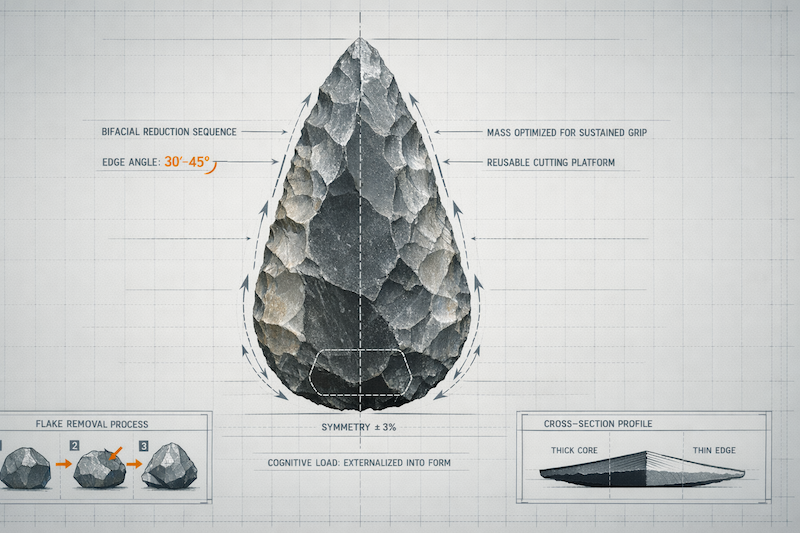
It’s our earliest feat of engineering.
Painstakingly crafted for repeatable performance across tasks—cutting, scraping, butchery, digging, impact.
Our best guess is it appeared nearly two million years ago and then remained essentially unchanged for over a MILLION years.
Breakthroughs emerged rarely, unfolding over centuries rather than moments. Then they stuck around for a long time.
Only recently has the rhythm reversed. And when it did, it didn't inch forward—it lurched.
That’s the backdrop for what’s unfolding now.
Which is why I’m booking a flight to a place I’ve never been.
To witness something no one has seen before.
And I won’t be alone.
Before we go any further, let’s step back and expand the frame on a known idea.
Moore’s Law Made New
Moore’s Law says the amount of computation you can buy for a fixed cost doubles on a predictable cadence.
But, here’s the thing…
What began as a technical observation in 1965 by the co-founder of Intel has since taken on a wider meaning, leaking into different fields.
For example, many scientists now apply Moore’s Law–style thinking to biological evolution. Geneticists Richard Gordon and Alexei Sharov propose (convincingly) that biological complexity grows exponentially on a long, surprisingly similar timescale.
Their theories imply that compounding may be a fundamental feature of life itself—and that what distinguishes our moment is not its existence, but its sudden acceleration.
Now, with that in mind, let’s zoom into the last century-plus.
Here’s a semi-log chart.
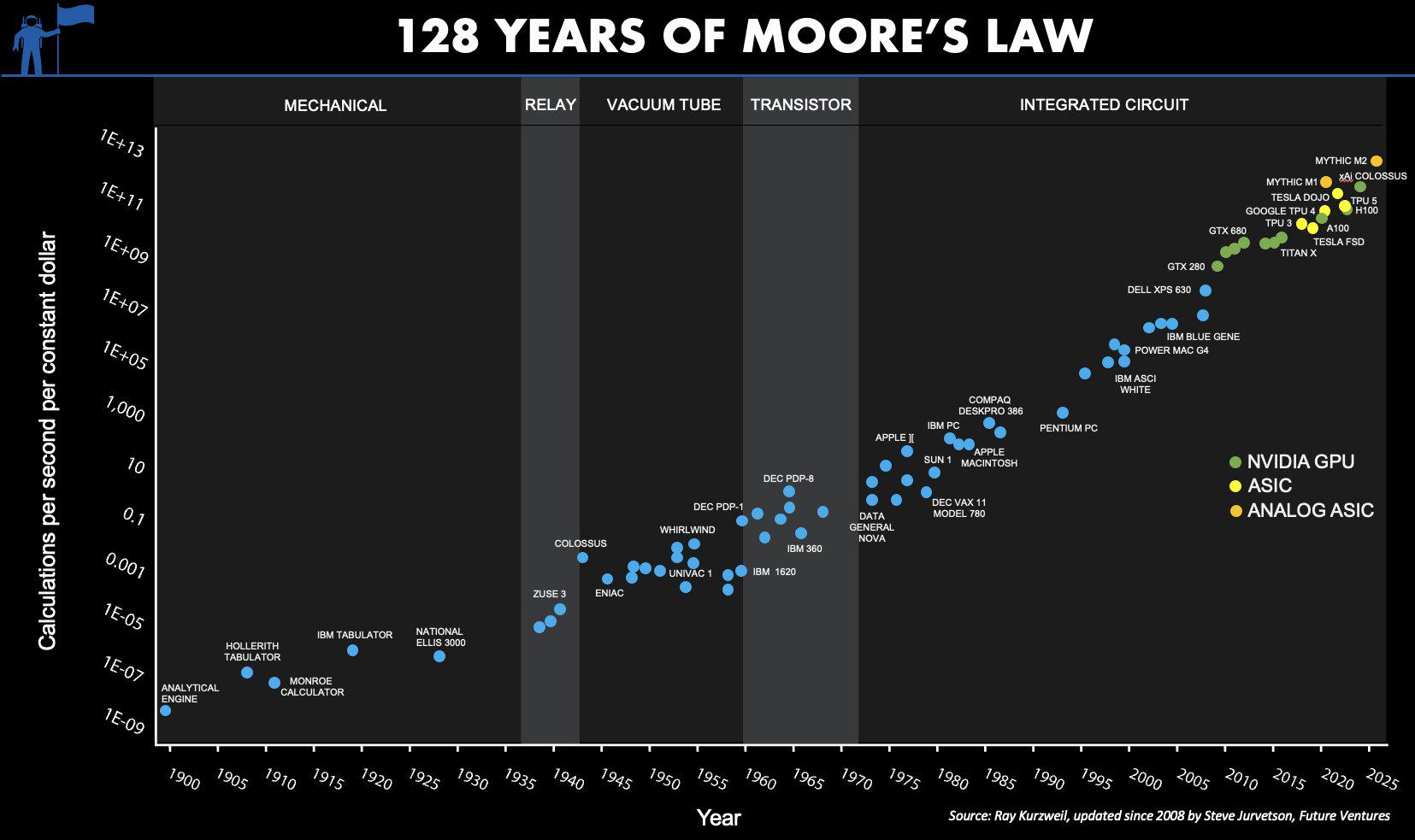
A straight line means exponential growth. Each tick on the y-axis is a 100× jump. The full span of this chart represents roughly a 1,000,000,000,000,000,000,000× improvement in computation per dollar.
Pause.
The curve began in the 1890s, when computation first moved from human hands to machines.
Punch-card tabulators turned information into a mechanical process, and from that moment on, humanity found ways to process more information with less time, energy, and cost.
Since then, humanity’s ability to compute has compounded for as long as we can measure it, long predating Gordon Moore’s 1965 observation.
Of course, the curve hasn’t been perfectly smooth. It advances through step changes driven by new paradigms rather than a single law of physics.
But while leadership on the curve has kept changing hands…
One planning assumption never stopped winning: the computational frontier will keep compounding, as it has for the past 128 years.
Right now, the next transfer on the curve seems to have begun, even if few are watching.
Break or Breakthrough?
It’s true.
Moore’s Law is finished in its original, narrow sense: transistors no longer shrink on a clean, predictable schedule. But the deeper pattern Moore identified—more computation per dollar over time—doesn’t seem to be stopping.
And, as the graph makes clear, the curve has never belonged to silicon or any one technology alone. It reflects our ability to keep discovering new ways forward.
When one path stalled, the curve didn’t quit. It changed direction.
Smaller transistors give way to better architectures. Speed gives way to efficiency. Generality gives way to specialization.
The curve didn’t die, it reorganized.
And, as it happens… March 16 sits at what we believe could be one of those reorganization moments.
Which is why our team is already making plans to head to California to witness it firsthand.

This, in short, is when we believe the economics begin to flip. When something that was theoretically possible becomes inevitable.
What happens then has been forming quietly for years… maybe centuries…
But after it, pretending nothing has changed becomes much harder.
And that’s usually how these moments work.
They may not describe it in these terms, yet it’s one reason our Paradigm experts gathered this week for the ALL-IN Summit.
A convergence is taking shape. March 16 is the hinge. And what follows rewards those already in motion.
If you missed it, click here for the FULL replay of the event.